Compound Interest Calculator - Future Value and Growth
Forecast multi-year compound interest growth, model regular savings contributions, and track your future account balance across custom compounding cycles.
🔒 Financial Data Privacy: All numbers are calculated strictly in your browser with zero server storage.
How to Calculate Compound Interest
- Enter your starting balance in Initial Deposit, your annual yield in Annual Interest Rate, and the total duration in Investment Horizon.
- Add any recurring deposit amount in Regular Contribution & Frequency and choose Monthly or Annually.
- Select your Compounding Frequency and Contribution Timing from the dropdown menus above.
- Review your ending balance, principal vs. interest chart, and full year-by-year growth schedule in the table below.
Parameters Explained
- Compounding Frequency: Sets how often earned interest is added back to your principal balance, from daily (365/yr) to annual (1/yr) cycles.
- Contribution Timing: Selects whether recurring deposits are made at the Beginning of period (earning interest immediately) or the End of period.
Key Features
- Five compounding frequency options covering daily, monthly, quarterly, semi-annual, and annual interest cycles.
- Flexible monthly or annual contribution schedules with beginning-of-period and end-of-period deposit timing.
- Visual donut chart comparing your total principal contributed against total compound interest earned.
- Complete year-by-year growth schedule for horizons up to 200 years with shareable links and CSV table downloads.
- Private calculation right in your web browser with zero external data collection or storage.
Compound Interest Formula and Calculation Logic
The Compound Interest Calculator projects future account balances by combining lump-sum compound growth with regular periodic contributions:
FV = P × (1 + r / n)^(n × t) + PMT × [ (1 + r / n)^(n × t) - 1 ] / (r / n)
Where FV is the ending balance, P is the initial deposit, PMT is the periodic contribution, r is the annual interest rate (in decimal form), n is the number of compounding periods per year, and t is the investment horizon in years.
For end-of-period deposits, each contribution starts earning interest in the next cycle, whereas beginning-of-period deposits earn interest immediately and multiply the contribution term by (1 + r / n).
When your contribution frequency differs from your compounding frequency, the calculator converts the annual yield into an equivalent periodic rate per deposit cycle and rounds annual figures to the nearest cent.
Developed and maintained by the ValuNox team, this savings growth tool follows standard banking compound interest formulas and US retail deposit conventions.
Financial Disclaimer
Results are for educational and estimation purposes only, not formal financial, tax, or legal advice. Projected returns assume constant annual yields and do not account for income taxes, inflation, account management fees, or market volatility.
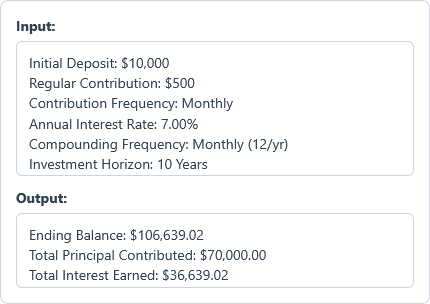
Example Calculation
Example Input
Initial Deposit: $10,000
Regular Contribution: $500
Contribution Frequency: Monthly
Annual Interest Rate: 7.00%
Compounding Frequency: Monthly (12/yr)
Investment Horizon: 10 Years
Options used: Contribution Timing: End of period
Example Output
Ending Balance: $106,639.02
Total Principal Contributed: $70,000.00
Total Interest Earned: $36,639.02
This example illustrates how compound interest accelerates over time, generating over one-third of the total portfolio within ten years.
Frequently Asked Questions
What is compound interest?
Compound interest is interest calculated on both your starting principal and the interest already added from earlier cycles. Because your interest earns its own interest, your savings balance grows at an accelerating pace over time.
How does compounding frequency affect investment returns?
More frequent compounding produces a higher total return for the same stated annual rate. Adding interest to your balance daily or monthly gives future cycles a slightly larger base to grow from than annual compounding.
What is the difference between beginning and end-of-period deposits?
Beginning-of-period deposits earn interest immediately during that initial cycle, while end-of-period deposits begin compounding in the following cycle. As a result, beginning deposits produce a slightly larger final portfolio value across identical time horizons.
How does inflation impact long-term compound growth?
Inflation reduces the future purchasing power of your savings even as your nominal balance grows. Because this tool projects nominal figures, you can estimate inflation-adjusted value by entering your expected real return (nominal interest rate minus annual inflation) in the Annual Interest Rate box.
How many years of compound growth can I model?
You can model any investment horizon from 1 to 200 whole years to plan for retirement, college savings, or long-term family wealth. Both the on-screen schedule and the downloadable CSV table list every single year in full.
Are my savings and investment numbers kept private?
Yes, all compound interest calculations happen directly in your web browser. Your deposit amounts, contribution schedules, and savings projections are never sent out or saved anywhere.