Net Worth Calculator - Track Assets and Liabilities
Track your personal net worth and debt-to-asset ratio by comparing everything you own against your outstanding debts.
🔒 Financial Data Privacy: All numbers are calculated strictly in your browser with zero server storage.
Assets (What You Own)
Liabilities (What You Owe)
How to Calculate Your Net Worth
- Fill in your cash, savings, investment accounts, retirement funds, real estate, and property values under Assets above.
- Add your current mortgage balance, auto loans, student loans, and credit card debt under Liabilities.
- Check your calculated net worth, total assets and liabilities, debt-to-asset ratio, and asset allocation chart below.
Key Features
- Instant personal balance sheet summary comparing your total owned assets against total outstanding debts.
- Separate inputs for cash, savings, stocks, retirement accounts (401k/IRA), real estate, and personal property.
- Automatic debt-to-asset ratio calculation to measure what percentage of your assets is financed by debt.
- Visual donut chart showing how your total assets are divided across each category.
- Shareable calculation links and sample data loading for quick household balance sheet comparisons.
- Complete privacy for your household balance sheet—every asset and debt figure stays strictly on your own screen.
Net Worth Calculation Formula and Balance Sheet Logic
The Net Worth Calculator calculates your net personal financial position using the fundamental balance sheet equation:
Net Worth = Total Assets - Total Liabilities
Debt-to-Asset Ratio = (Total Liabilities / Total Assets) × 100%
Where Total Assets is the sum of your cash, savings, investments, retirement accounts, real estate market value, and personal property. Total Liabilities is the combined sum of your mortgage balance, auto loans, student loans, and credit card debt.
The Debt-to-Asset Ratio shows the percentage of your total assets owed to lenders. When total assets equal zero, the ratio displays 0.0% if you have no debt, or Undefined (No Assets) when debts exist without assets.
Rounding each individual entry to the exact cent keeps your asset totals, debt balances, and final net worth in complete agreement, even when liabilities exceed assets.
Developed and maintained by the ValuNox team, this tool applies established household accounting rules to deliver clear, dependable net worth and leverage estimates.
Financial Disclaimer
Results are for educational and estimation purposes only, not formal financial, tax, or legal advice. Property values and investment balances change with the market, and future taxes on pre-tax retirement accounts are not deducted here.
Example Calculation
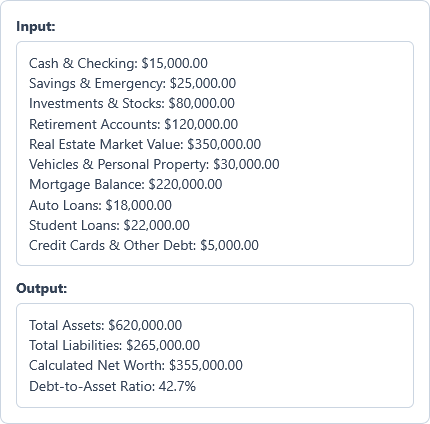
Example Input
Cash & Checking: $15,000.00
Savings & Emergency: $25,000.00
Investments & Stocks: $80,000.00
Retirement Accounts: $120,000.00
Real Estate Market Value: $350,000.00
Vehicles & Personal Property: $30,000.00
Mortgage Balance: $220,000.00
Auto Loans: $18,000.00
Student Loans: $22,000.00
Credit Cards & Other Debt: $5,000.00
Example Output
Total Assets: $620,000.00
Total Liabilities: $265,000.00
Calculated Net Worth: $355,000.00
Debt-to-Asset Ratio: 42.7%
Subtracting $265,000.00 in total debt from $620,000.00 in owned assets leaves this household with $355,000.00 in positive net worth and a healthy 42.7% debt-to-asset ratio.
Frequently Asked Questions
What is net worth and why does tracking it matter?
Net worth measures your overall financial standing by calculating the exact difference between what you own (assets) and what you owe (liabilities). Tracking this balance over time reveals whether you are truly building wealth or simply funding lifestyle inflation through debt.
How do you distinguish between assets and liabilities?
Assets are items you own that hold cash or resale value, while liabilities are debts you owe to lenders. For instance, your home's market value is an asset, while the remaining mortgage balance on it is a liability.
Can your calculated net worth be a negative number?
Yes, your net worth is negative whenever your total debts are higher than the total value of your assets. This is common for recent graduates paying off student loans or buyers who recently financed a car or home.
Should vehicles and personal property be included in net worth?
Yes, but list them at their realistic current resale value rather than what you originally paid. Because cars and personal items lose value quickly, using realistic resale numbers keeps your net worth accurate.
What is considered a healthy debt-to-asset ratio?
A debt-to-asset ratio below 50% generally shows a strong financial position where you own more than twice what you owe. New homeowners often have ratios above 60% at first, which drops steadily as the mortgage is paid down.
How should pre-tax retirement accounts be valued on a balance sheet?
Pre-tax accounts like traditional 401(k)s and traditional IRAs are typically listed at their current account balance. Keep in mind that future withdrawals will be taxed as income based on your tax bracket in retirement.
Does anyone else see the asset or loan numbers I enter?
No, every balance you type is totaled directly on your own device. Your savings, property values, and debt figures are never saved, tracked, or sent anywhere online.