Budget Calculator - 50/30/20 Rule and Cash Flow
Plan your monthly cash flow, 50/30/20 budget allocations, and personal savings rate from your after-tax take-home pay.
🔒 Financial Data Privacy: All numbers are calculated strictly in your browser with zero server storage.
Monthly Net Income
Savings & Debt Payoff (20%)
Essential Needs (50%)
Discretionary Wants (30%)
How to Calculate Your Monthly Budget
- Enter your primary and side after-tax take-home pay into the Monthly Net Income boxes above.
- Enter your required living costs under Essential Needs (50%) and lifestyle spending under Discretionary Wants (30%).
- Add your monthly transfers to emergency savings, investments, and extra loan payments under Savings & Debt Payoff (20%).
- Review your net monthly cash flow, 50/30/20 comparison table, personal savings rate, and allocation chart below.
Key Features
- Instant monthly cash flow summary showing whether your household budget runs a surplus, zero-based balance, or deficit.
- Side-by-side 50/30/20 rule comparison table measuring your actual spending against target dollar amounts and percentages.
- Automatic personal savings rate calculation tracking the share of take-home pay going toward savings and extra debt payoff.
- Visual donut chart displaying how your total monthly outflows are split across needs, wants, and savings.
- One-click link sharing and built-in sample figures to test different monthly spending plans.
- Confidential household budgeting where your take-home pay, monthly bills, and savings goals stay on your device.
50/30/20 Budgeting Rule and Cash Flow Logic
The Budget Calculator organizes your monthly take-home pay using zero-based budgeting principles and the 50/30/20 rule. It compares your net income against essential needs, discretionary wants, and savings to calculate your net cash flow and personal savings rate.
Total Outflows (E) = N + W + S
Net Cash Flow (Δ) = I - E
50/30/20 Targets: Target Needs = 0.50 × I | Target Wants = 0.30 × I | Target Savings = I - Target Needs - Target Wants (20%)
Category Variance: Needs Variance = N - Target Needs | Wants Variance = W - Target Wants | Savings Variance = S - Target Savings
Personal Savings Rate (SR) = (S / I) × 100%   (when I > 0)
Where I is total net monthly income, N is essential needs (housing, utilities, groceries, transportation, insurance, minimum loan payments), and W is discretionary wants (dining, entertainment, shopping, travel). S represents savings and extra debt payoff (emergency fund, investments, and extra principal payments). A positive cash flow (Δ > 0) shows a monthly cash surplus, while a negative balance (Δ < 0) indicates a monthly budget deficit.
Each category is rounded to the nearest cent, and the 20% savings target reconciles any odd penny so your 50/30/20 target allocations always add up to 100% of total net income.
Developed and maintained by the ValuNox team, this budgeting tool follows standard 50/30/20 allocation rules and household cash flow accounting principles.
Financial Disclaimer
Results are for educational and estimation purposes only, not formal financial, tax, or legal advice. Real-world living expenses, regional cost-of-living variances, and personal debt obligations vary by location and household circumstances.
Example Calculation
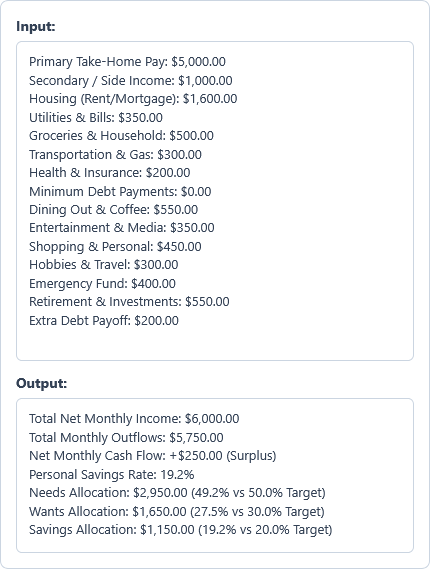
Example Input
Primary Take-Home Pay: $5,000.00
Secondary / Side Income: $1,000.00
Housing (Rent/Mortgage): $1,600.00
Utilities & Bills: $350.00
Groceries & Household: $500.00
Transportation & Gas: $300.00
Health & Insurance: $200.00
Minimum Debt Payments: $0.00
Dining Out & Coffee: $550.00
Entertainment & Media: $350.00
Shopping & Personal: $450.00
Hobbies & Travel: $300.00
Emergency Fund: $400.00
Retirement & Investments: $550.00
Extra Debt Payoff: $200.00
Example Output
Total Net Monthly Income: $6,000.00
Total Monthly Outflows: $5,750.00
Net Monthly Cash Flow: +$250.00 (Surplus)
Personal Savings Rate: 19.2%
Needs Allocation: $2,950.00 (49.2% vs 50.0% Target)
Wants Allocation: $1,650.00 (27.5% vs 30.0% Target)
Savings Allocation: $1,150.00 (19.2% vs 20.0% Target)
With $6,000.00 in monthly net income, keeping essential needs at 49.2% and wants at 27.5% leaves a $250.00 monthly cash surplus alongside a 19.2% personal savings rate.
Frequently Asked Questions
How does the 50/30/20 budgeting rule work?
The 50/30/20 rule divides your after-tax take-home pay into three buckets: 50% for essential needs, 30% for discretionary wants, and 20% for savings and extra debt payoff. It gives you a simple benchmark to keep living costs balanced without tracking every small purchase.
Why do minimum debt payments belong in needs rather than the savings and debt bucket?
Minimum loan payments are required monthly bills needed to avoid late fees and protect your credit score. Only extra principal payments above the minimum belong in the 20% savings and debt payoff category because they reduce your debt balance faster and save on interest.
What should you do if your budget shows a monthly deficit?
Start by trimming discretionary wants like dining out, subscriptions, and shopping before touching essential bills. If cutting wants does not close the deficit, look for ways to lower fixed bills like insurance or increase your monthly take-home pay.
How should freelancers or individuals with irregular income structure their monthly budget?
Base your monthly budget on your lowest earning month from the past year rather than an average. Cover all essential needs from that conservative baseline, and send extra income from stronger months toward emergency savings, tax reserves, and debt payoff.
What is the difference between a monthly cash surplus and the personal savings rate?
A monthly cash surplus is unallocated money left over after subtracting all bills, wants, and planned savings from your income. Your personal savings rate measures the percentage of net income directed into emergency savings, investments, and extra debt payments.
Is my monthly income and spending data stored anywhere?
No, your budget is calculated right on your screen without saving any personal data. Your paycheck amounts, living costs, and savings goals remain on your device and are never uploaded or shared.
How often should you review and update your personal budget?
Review your budget once a month to compare actual spending against your targets, and update your numbers whenever your income, rent, or loan payments change. Regular monthly check-ins help prevent lifestyle creep and keep your savings rate on target.