Down Payment Calculator - Estimate Cash to Close
Estimate the upfront cash needed to buy a home, compare LTV payment tiers, and track your monthly savings timeline.
🔒 Financial Data Privacy: All numbers are calculated strictly in your browser with zero server storage.
How to Calculate Your Home Down Payment
- Enter the property price in Home Purchase Price ($) and set your upfront contribution in either Target Down Payment ($ / %) box above.
- Add your Estimated Closing Costs ($ / %), Annual Mortgage Interest Rate (%), Mortgage Loan Term (Years), and optional Annual PMI Rate (%).
- Fill in Current Cash Saved ($) and Monthly Savings ($/mo) & APY (%) to project how many months it will take to fund your purchase.
- Review your total cash to close, funding chart, and LTV comparison table below to compare monthly and lifetime borrowing costs.
Parameters Explained
- Target Down Payment ($ / %): Converts between dollar amounts and home price percentages to set your starting loan principal and Loan-to-Value (LTV) ratio.
- Estimated Closing Costs ($ / %): Converts between flat fees and price percentages (up to 30%) for origination, appraisal, title insurance, or transfer taxes.
- Monthly Savings ($/mo) & APY (%): Combines monthly deposits with monthly compound interest to calculate the exact months needed to cover your shortfall.
Key Features
- Automatic dollar-to-percentage conversion for both your target down payment and estimated closing costs.
- Complete upfront cash-to-close calculation that combines down payment funds with buyer closing fees or property transfer taxes.
- Compound savings timeline that calculates the exact months, new deposits, and interest earned needed to bridge your cash shortfall.
- Side-by-side LTV tier comparison table benchmarking 3.5%, 5%, 10%, 15%, 20%, and 25% down payments alongside your custom percentage.
- Automated Private Mortgage Insurance (PMI) tracking that removes monthly PMI the exact month your loan balance reaches 80% LTV.
- Visual cash-to-close donut chart and savings progress bar comparing current savings against remaining down payment and closing cost needs.
Down Payment and Cash-to-Close Formula
The Down Payment Calculator estimates your upfront cash to close, loan principal, and savings timeline using standard banking formulas:
Down Payment ($) = Home Price × (Down Payment % / 100)
Closing Costs ($) = Home Price × (Closing Costs % / 100)
Total Cash to Close = Down Payment + Closing Costs
Loan Principal (P) = Home Price - Down Payment   [LTV = (P / Home Price) × 100%]
Monthly P&I = P × [ r(1 + r)^n ] / [ (1 + r)^n - 1 ]   (or P / n if r = 0)
Monthly Savings Balance (B_m) = B_{m-1} × (1 + APY / 12) + Monthly Deposit
Here, P is the starting loan principal, r is the monthly interest rate, and n is the total monthly payments. Putting down less than 20% (LTV > 80%) adds monthly PMI equal to (P × Annual PMI Rate) / 12. That PMI charge stops automatically once scheduled principal payments bring your remaining loan balance down to 80% LTV.
To estimate your savings timeline, your Current Cash Saved is subtracted from Total Cash to Close to find your remaining shortfall. Each month, your balance earns compound interest at APY / 12 plus your Monthly Savings deposit. This cycle repeats each month until your accumulated balance reaches your upfront cash goal.
Monthly principal, interest, and PMI across all LTV tiers are rounded to the cent, adjusting the final payment to reach $0.00.
Developed and maintained by the ValuNox team, this down payment calculator models upfront cash-to-close needs, compound savings timelines, and LTV payment tiers.
Financial Disclaimer
Results are for educational and estimation purposes only, not formal financial, tax, or legal advice. Actual closing costs, transfer taxes, PMI cancellation rules, and savings yields depend on your lender, loan program, jurisdiction, and credit profile.
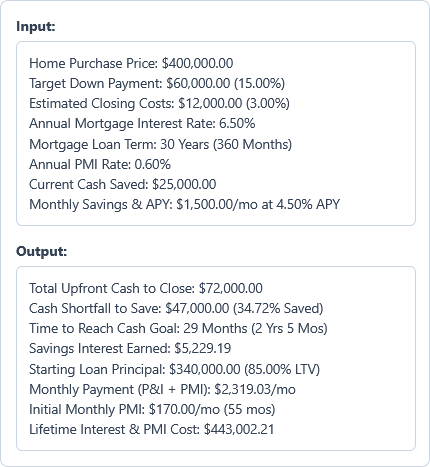
Example Calculation
Example Input
Home Purchase Price: $400,000.00
Target Down Payment: $60,000.00 (15.00%)
Estimated Closing Costs: $12,000.00 (3.00%)
Annual Mortgage Interest Rate: 6.50%
Mortgage Loan Term: 30 Years (360 Months)
Annual PMI Rate: 0.60%
Current Cash Saved: $25,000.00
Monthly Savings & APY: $1,500.00/mo at 4.50% APY
Example Output
Total Upfront Cash to Close: $72,000.00
Cash Shortfall to Save: $47,000.00 (34.72% Saved)
Time to Reach Cash Goal: 29 Months (2 Yrs 5 Mos)
Savings Interest Earned: $5,229.19
Starting Loan Principal: $340,000.00 (85.00% LTV)
Monthly Payment (P&I + PMI): $2,319.03/mo
Initial Monthly PMI: $170.00/mo (55 mos)
Lifetime Interest & PMI Cost: $443,002.21
A 15.00% down payment ($60,000.00) plus 3.00% in closing costs ($12,000.00) requires $72,000.00 in total upfront cash. Saving $1,500.00 monthly at 4.50% APY on top of $25,000.00 covers the $47,000.00 shortfall in 29 months (including $5,229.19 in interest). Raising the down payment to 20.00% ($80,000.00) removes $9,350.00 in PMI and cuts lifetime borrowing costs by $34,861.57.
Frequently Asked Questions
How much down payment do I need to buy a house?
You typically need between 3% and 20% of the purchase price depending on your country, loan program, and credit profile. Minimums often start at 3% to 5% for US loans or 5% to 10% internationally, while 20% down eliminates PMI.
What is the difference between a down payment and cash to close?
Your down payment goes directly toward home equity, while cash to close is the total amount due on closing day. Cash to close adds closing fees—like origination, appraisal, title, or stamp duty charges—minus earnest money or seller credits.
Why does a 20% down payment eliminate Private Mortgage Insurance (PMI)?
Putting 20% down sets your starting Loan-to-Value (LTV) ratio at 80%, giving the lender a 20% equity cushion against default. With less than 20% down on a conventional loan, lenders charge monthly PMI until your balance reaches 80% LTV.
Should I drain all of my savings to make a larger down payment?
No, you should keep three to six months of expenses in an emergency fund plus cash for moving and repairs. Draining all liquid cash to avoid PMI leaves you vulnerable to sudden home repairs or income loss after closing.
Where should I keep my house down payment savings while I save?
Keep your down payment in a high-yield savings account (HYSA), money market account, or short-term CD to protect your principal. When buying within one to five years, stock market drops could shrink your cash right before you make an offer.
Are my home price, down payment, and savings balances kept private?
Yes, every cash-to-close estimate, savings timeline, and LTV comparison is calculated right on your screen. Your home price, current savings, and monthly deposit figures stay strictly on your own device and are never stored or shared.