DTI Ratio Calculator - Calculate Debt-to-Income Ratio
Measure your monthly housing and total debt ratios against pre-tax income to check 28/36, QM, and FHA borrowing limits.
🔒 Financial Data Privacy: All numbers are calculated strictly in your browser with zero server storage.
How to Calculate Your Debt-to-Income Ratio
- Enter your pre-tax salary and any co-borrower or side earnings under Gross Income (Before Taxes) above.
- Fill in your monthly rent or mortgage payment, property taxes, insurance, and HOA dues under Monthly Housing Expenses (Front-End).
- Add your required monthly payments for auto loans, student loans, credit cards, and other obligations under Recurring Monthly Debts (Back-End).
- Review your front-end and back-end DTI percentages, lender underwriting benchmark table, and income allocation chart below.
Parameters Explained
- Income Period (/ Month or / Year): Sets whether your primary and co-borrower gross income figures are entered as monthly amounts or annual totals (automatically divided by 12).
Key Features
- Side-by-side calculation of front-end (housing) and back-end (total debt) ratios from your gross income.
- Monthly and annual income option that converts yearly salaries and co-borrower earnings into monthly gross figures.
- Underwriting benchmark table comparing your debt against 28%, 36%, 43% QM, and 50% FHA limits with exact dollar headroom.
- Color-coded ratio progress bars and a visual donut chart breaking down housing costs, recurring debts, and remaining income.
- Shareable calculation links and a sample borrower profile for testing mortgage pre-approval budgets.
- Private debt-to-income evaluation that keeps your salary, housing costs, and monthly loan obligations strictly on your own device.
Debt-to-Income (DTI) Ratio Formula and Lending Benchmarks
The DTI Ratio Calculator measures your monthly debt burden by comparing housing expenses and recurring debt obligations against your pre-tax income. Lenders evaluate two distinct debt-to-income ratio figures during loan underwriting:
Front-End DTI = (Monthly Housing Debt / Total Monthly Gross Income) × 100%
Back-End DTI = (Total Monthly Debt / Total Monthly Gross Income) × 100%
Max Allowed Debt (D_max) = Total Monthly Gross Income × Benchmark Cap %
Available Headroom (ΔD) = D_max - Actual Monthly Debt
Where Monthly Housing Debt sums rent or mortgage principal and interest (P&I), property taxes, home insurance, HOA dues, and PMI. Total Monthly Debt adds minimum payments for auto, student, personal, and credit card debt plus court-ordered support.
Under the 28/36 Rule (similar to international GDS and TDS limits), housing costs stay within 28% of gross income and total debt within 36%. For home mortgages, 43% is the standard Qualified Mortgage (QM) cap. Meanwhile, 50% is the typical ceiling for FHA or manually underwritten loans with strong compensating factors.
Annual salaries converted to monthly income are rounded to the nearest cent. This keeps your maximum debt limits and remaining borrowing room aligned without penny gaps.
Developed and maintained by the ValuNox team, this underwriting ratio calculator aligns with standard 28/36 banking guidelines, US residential mortgage thresholds, and international debt-service benchmarks.
Financial Disclaimer
Results are for educational and estimation purposes only, not formal financial, tax, or legal advice. Actual loan qualification depends on lender underwriting overlays, credit scores, verified tax returns, liquid cash reserves, and loan program guidelines.
Example Calculation
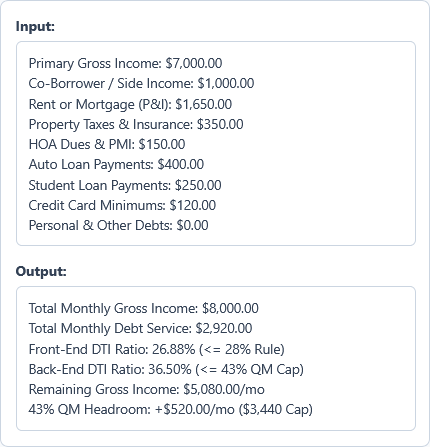
Example Input
Primary Gross Income: $7,000.00
Co-Borrower / Side Income: $1,000.00
Rent or Mortgage (P&I): $1,650.00
Property Taxes & Insurance: $350.00
HOA Dues & PMI: $150.00
Auto Loan Payments: $400.00
Student Loan Payments: $250.00
Credit Card Minimums: $120.00
Personal & Other Debts: $0.00
Options used: Income Period: / Month
Example Output
Total Monthly Gross Income: $8,000.00
Total Monthly Debt Service: $2,920.00
Front-End DTI Ratio: 26.88% (<= 28% Rule)
Back-End DTI Ratio: 36.50% (<= 43% QM Cap)
Remaining Gross Income: $5,080.00/mo
43% QM Headroom: +$520.00/mo ($3,440 Cap)
With $8,000.00 in monthly gross income, $2,150.00 in housing costs keeps the front-end ratio at 26.88%, safely below the 28% guideline. Adding $770.00 in other monthly debts raises the back-end ratio to 36.50%. That sits $40.00 above the 36% target, but leaves $520.00 in monthly headroom under the 43% QM cap.
Frequently Asked Questions
What is the difference between front-end and back-end DTI ratios?
Your front-end DTI ratio only measures housing costs—including mortgage principal, interest, property taxes, homeowners insurance, and HOA dues—against your gross monthly income. Your back-end DTI ratio combines those housing costs with all other recurring monthly debts, such as auto loans, student loans, and credit card minimums.
Why do lenders use gross income instead of net take-home pay to calculate DTI?
Lenders use pre-tax gross income because it provides a uniform baseline across all borrowers. Take-home pay varies widely based on 401(k) contributions, health insurance deductions, and tax withholding choices. Standard lending limits like the 28/36 rule are already set for pre-tax income.
Which monthly living expenses are left out of a DTI calculation?
Everyday living costs that do not appear as recurring debt obligations on your credit report are excluded from DTI. Utilities, groceries, gas, cell phone bills, auto insurance, health insurance premiums, and streaming subscriptions are not counted in your debt-to-income ratio.
How do credit card balances count toward your debt-to-income ratio?
Underwriters count only the minimum monthly payment shown on your credit card statement, not your total card balance. Even if you pay your card in full each month, lenders still use the required minimum payment on your credit report.
How are student loans in deferment or income-driven repayment counted in DTI?
When a deferred student loan shows a $0 monthly payment, mortgage lenders usually count 0.5% or 1% of your total loan balance each month. If you use an approved income-driven repayment (IDR) plan, many loan programs accept your documented monthly IDR payment.
What is the fastest way to lower your DTI ratio before applying for a mortgage?
Paying off a small installment loan or reducing credit card balances lowers your required monthly payments right away. Partial extra payments on an auto or personal loan do not lower your DTI unless the loan is recast or paid in full.
Can lenders or third parties see the income and debt numbers I enter?
No, all debt-to-income ratios and lending limits are calculated directly on your device. Your gross income, housing costs, and monthly debt figures stay on your screen and are never saved, tracked, or shared.