Savings Goal Calculator - Target Deposit & Timeline
Find required monthly, bi-weekly, weekly, or annual deposits to reach your savings goal from starting funds and compound interest.
🔒 Financial Data Privacy: All numbers are calculated strictly in your browser with zero server storage.
How to Calculate Your Savings Goal
- Enter your target amount in Savings Goal and any existing funds in Current Savings (enter 0 if starting from scratch).
- Set your target timeframe in Time to Goal (Years or Months) and enter your expected yield in Annual Interest Rate.
- Choose how often you plan to save under Deposit Frequency and how often your account pays interest under Compounding Frequency.
- Compare your required periodic deposit, equivalent deposit breakdown, three-way savings chart, and accumulation schedule below.
Parameters Explained
- Time Unit (Years or Months): Selects your savings horizon in whole years (1 to 100 years) or exact months (1 to 1,200 months), automatically displaying a month-by-month table for targets up to 36 months.
- Deposit Frequency: Sets how often you contribute new funds—monthly (12/yr), bi-weekly (26/yr), weekly (52/yr), or annually (1/yr)—to match your paycheck or budgeting cycle.
- Compounding Frequency: Defines how often your bank or investment account adds earned interest back into the balance—daily (365/yr), monthly (12/yr), quarterly (4/yr), semi-annually (2/yr), or annually (1/yr).
Key Features
- Target deposit calculation across monthly (12/yr), bi-weekly (26/yr), weekly (52/yr), and annual (1/yr) contribution schedules.
- Side-by-side deposit equivalents right below your primary result so you can compare monthly, bi-weekly, and weekly savings amounts at a glance.
- Automatic interest rate conversion across daily (365/yr), monthly (12/yr), quarterly (4/yr), semi-annual (2/yr), and annual (1/yr) compounding cycles.
- Three-part donut chart and principal-to-interest ratio bar separating current savings, new deposits, and compound interest earned.
- Monthly and annual accumulation table showing month-by-month progress up to 36 months or yearly summaries up to 100 years, with CSV export and shareable links.
- Private browser calculation so your savings goal, starting balance, and deposit plan never leave your device.
Savings Goal and Sinking Fund Formula
The Savings Goal Calculator finds the periodic deposit needed to reach your target balance by combining compound growth on current funds with the sinking fund formula:
r_p = (1 + r / n)^(n / m) - 1
FV_0 = P × (1 + r_p)^N
PMT = (G - FV_0) × r_p / [ (1 + r_p)^N - 1 ]
Where G is your target savings goal, P is your current savings balance, and r is the annual decimal interest rate. For the timeline, n counts yearly compounding cycles, m counts yearly deposits, t is the time in years, and N = t × m is the total deposit count.
First, the annual rate is converted into an effective periodic yield (r_p) matching your deposit schedule. Next, your starting balance is compounded forward to find its future value (FV_0) at the end of the timeline. If FV_0 already meets or exceeds G, the required deposit is $0.00 and the calculator displays your projected surplus. Otherwise, the remaining shortfall (G - FV_0) is divided across N compounding deposit periods (or divided evenly as (G - P) / N when the interest rate is 0%).
Required deposits and schedule rows are rounded to the nearest cent so starting funds, new contributions, and compound interest match the projected ending balance.
Developed and maintained by the ValuNox team, this savings goal calculator models periodic deposit targets using standard sinking fund formulas and retail banking conventions.
Financial Disclaimer
Results are for educational and estimation purposes only, not formal financial, tax, or legal advice. Projected figures assume a constant interest rate and regular deposits on schedule. Actual bank returns vary with rate changes, taxes, inflation, and account fees.
Example Calculation
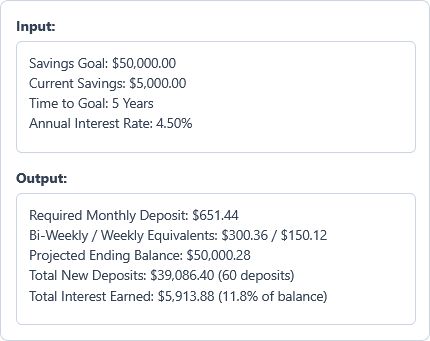
Example Input
Savings Goal: $50,000.00
Current Savings: $5,000.00
Time to Goal: 5 Years
Annual Interest Rate: 4.50%
Options used: Time Unit: Years | Deposit Frequency: Monthly (12/yr) | Compounding Frequency: Monthly (12/yr)
Example Output
Required Monthly Deposit: $651.44
Bi-Weekly / Weekly Equivalents: $300.36 / $150.12
Projected Ending Balance: $50,000.28
Total New Deposits: $39,086.40 (60 deposits)
Total Interest Earned: $5,913.88 (11.8% of balance)
Compounding the $5,000.00 starting balance and 60 monthly deposits at 4.50% generates $5,913.88 in total interest over five years. Together with your starting funds, that interest reduces the new deposits needed for the $50,000.00 goal to $39,086.40 ($651.44 per month).
Frequently Asked Questions
How does my starting balance lower the required periodic deposit?
Your starting balance reduces your required deposit in two ways: it immediately narrows the gap to your target amount and earns compound interest across the entire timeline. That accumulated interest further reduces the remaining shortfall that must be funded through new periodic deposits.
Why is a bi-weekly deposit different from half of a monthly deposit?
A bi-weekly schedule includes 26 deposits per year (equivalent to 13 four-week cycles), whereas a monthly schedule includes only 12 deposits per year. Because your contributions are spread across two extra pay periods and begin compounding slightly earlier, each bi-weekly deposit is smaller than half of the monthly amount.
What happens if my current savings already exceed my goal after compounding?
The required periodic deposit drops to $0.00 because your existing balance will reach and surpass your target on its own. In that case, the summary card displays your projected dollar surplus at the end of the timeline without any new contributions.
How can I account for inflation and income taxes on savings interest?
You can adjust for taxes and inflation by entering your net real yield into the Annual Interest Rate box. In taxable accounts—such as savings reported on IRS Form 1099-INT in the US or interest-bearing deposits worldwide—interest is typically taxed as ordinary income. Subtracting the tax portion of your yield and the expected inflation rate gives a realistic purchasing-power target.
Which accounts work best for short-term and medium-term savings goals?
High-yield savings accounts (HYSAs), money market accounts, and fixed-term deposits or certificates of deposit (CDs) work well for one- to five-year goals. They protect your principal while paying steady interest: HYSAs fit ongoing monthly or bi-weekly deposits, while CDs lock in fixed rates for lump sums.
Is my savings goal plan stored or shared online?
No, all target deposit and interest calculations happen right in your web browser. We never record or store your savings goal, current balance, or accumulation schedule.