Rule of 72 Calculator - Doubling Time & Interest Rate
Compare the Rule of 72 against exact logarithmic compounding to find investment doubling time or required annual yields.
🔒 Financial Data Privacy: All numbers are calculated strictly in your browser with zero server storage.
How to Calculate Your Investment Doubling Time
- Choose Years to Double (from Interest Rate) or Interest Rate Needed (from Target Years) under Calculation Mode.
- Enter your expected Annual Interest Rate (%) or your Target Time to Double (Years) in the second box above.
- Enter an optional Starting Principal ($) (or leave it blank to use the $10,000.00 default) and select your Compounding Frequency.
- Review the Rule of 72 estimate, exact compound result, accuracy variance, growth chart, and 2x to 16x doubling schedule below.
Parameters Explained
- Calculation Mode: Chooses between finding the years to double your money from a known interest rate and finding the annual rate needed for a target timeline.
- Compounding Frequency: Selects how many times per year interest compounds in the exact logarithmic formula, from annual (1/yr) to continuous (e^rt) compounding.
Key Features
- Two-way calculation solving for either years to double from a known interest rate or the interest rate needed for a target timeline, with automatic year-and-month conversions.
- Side-by-side benchmark comparison contrasting the Rule of 72 against exact logarithmic compounding, the Rule of 70, and the Rule of 69.3, complete with a percentage accuracy gauge.
- Six compounding frequency options covering annual (1/yr), semi-annual (2/yr), quarterly (4/yr), monthly (12/yr), daily (365/yr), and continuous (e^rt) interest schedules.
- Multi-doubling milestone table tracking cumulative years, rule variance, and projected balances across four consecutive doubling cycles (1x to 16x).
- Visual donut chart comparing starting principal against compound growth at your first doubling (2x), paired with shareable calculation links and CSV table downloads.
- All doubling timelines, yield targets, and 2x-to-16x balances are calculated privately in your browser.
Rule of 72 Formula and Logarithmic Doubling Math
The Rule of 72 Calculator estimates investment doubling time and required annual yields by comparing the classic mental-math shortcut against exact logarithmic compounding:
Rule of 72 Years (t_72) = 72 / R   |   Rule of 72 Rate (R_72) = 72 / t
Exact Periodic Doubling Time (t) = ln(2) / [ n × ln(1 + r / n) ]
Exact Periodic Required Rate (r) = n × [ 2^(1 / (n × t)) - 1 ]
Continuous Compounding (e^rt): t = ln(2) / r ≈ 69.3147 / R
Where R is the stated percentage rate (such as 8 for 8%), and r = R / 100 is its decimal equivalent. Here, n represents the compounding periods per year, t is the doubling time in years, and ln(2) ≈ 0.693147 is the natural logarithm of 2.
Under continuous compounding, doubling occurs when r × t = ln(2) ≈ 0.693147, which forms the basis for the Rule of 69.3 (69.3 / R). Because discrete annual compounding grows slightly slower than continuous compounding, the ideal rule numerator increases above 69.3 as interest rates rise. At an 8% annual yield, exact doubling takes ln(2) / ln(1.08) ≈ 9.0065 years (8 × 9.0065 = 72.05). As a result, 72 closely matches annual compounding across typical market returns of 6% to 10%. By contrast, the Rule of 70 provides closer estimates at lower annual yields between 1% and 4%.
Each doubling timeline and rate variance is rounded to two decimal places, while projected balances from 2x to 16x are rounded to the nearest cent.
Developed and maintained by the ValuNox team, this Rule of 72 calculator compares classic mental-math shortcuts against exact logarithmic compound interest formulas.
Financial Disclaimer
Results are for educational and estimation purposes only, not formal financial, tax, or legal advice. Both the Rule of 72 shortcut and logarithmic formulas assume a constant annual yield with full interest reinvestment. In practice, changing interest rates, taxes, account fees, and inflation will affect how long it takes to double your money.
Example Calculation
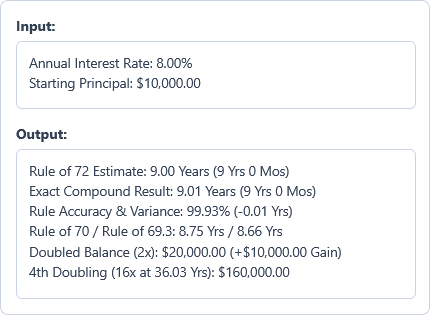
Example Input
Annual Interest Rate: 8.00%
Starting Principal: $10,000.00
Options used: Calculation Mode: Years to Double (from Interest Rate) | Compounding Frequency: Annually (1/yr - Classic Rule of 72)
Example Output
Rule of 72 Estimate: 9.00 Years (9 Yrs 0 Mos)
Exact Compound Result: 9.01 Years (9 Yrs 0 Mos)
Rule Accuracy & Variance: 99.93% (-0.01 Yrs)
Rule of 70 / Rule of 69.3: 8.75 Yrs / 8.66 Yrs
Doubled Balance (2x): $20,000.00 (+$10,000.00 Gain)
4th Doubling (16x at 36.03 Yrs): $160,000.00
At an 8.00% annual yield with annual compounding, the Rule of 72 estimates 9.00 years against the exact 9.01-year timeline (99.93% accuracy, within 0.08 months). Across four doubling cycles, the $10,000.00 principal doubles to $20,000.00 first and reaches $160,000.00 at year 36.03.
Frequently Asked Questions
Why does the Rule of 72 use 72 instead of 69.3 or 70?
The Rule of 72 uses 72 because annual compounding takes slightly longer to double than continuous compounding (69.3 / R), and 72 is much easier to divide in your head. At a typical 8% annual return, exact doubling takes 9.0065 years (8 × 9.0065 = 72.05), and 72 divides evenly by 1, 2, 3, 4, 6, 8, 9, and 12.
When should I use the Rule of 70 or the Rule of 69.3 instead of the Rule of 72?
Use the Rule of 70 for low annual rates between 1% and 4% (such as inflation or economic growth), and use the Rule of 69.3 for daily or continuous compounding. Because frequent compounding and lower yields stay closer to the continuous base of 69.31, those two shortcuts match the exact formula more closely than dividing by 72.
Why does the Rule of 72 become less accurate at very high interest rates?
The Rule of 72 loses accuracy above 20% because the linear mental shortcut underestimates how much discrete annual compounding slows relative to continuous growth. For example, at a 50% annual rate, 72 / 50 predicts 1.44 years, whereas the exact logarithmic formula requires 1.71 years to double.
Can the Rule of 72 measure how fast inflation or fees cut my purchasing power in half?
Yes, dividing 72 by an annual inflation rate or investment fee percentage estimates how many years it takes for your purchasing power to fall by half. At a 3% annual inflation rate, for instance, uninvested cash loses roughly 50% of its real buying power in about 24 years (72 / 3).
Does the Rule of 72 apply to simple interest accounts or recurring monthly deposits?
No, the Rule of 72 applies only to a single lump-sum balance that reinvests 100% of its earned interest. Simple interest accounts double in 100 / R years because interest never compounds. Accounts with ongoing monthly deposits double much faster and require a compound interest or savings goal calculator.
How does this calculator protect the privacy of my financial numbers?
Every doubling estimate and milestone table is calculated directly in your web browser. Your starting principal and interest rate are never sent, saved, or shared anywhere online.