Hourly to Salary Calculator - Convert Wages & Paychecks
Compare your hourly rate, periodic paychecks, and annual gross salary across custom workweeks, unpaid leave, and overtime pay.
🔒 Financial Data Privacy: All numbers are calculated strictly in your browser with zero server storage.
How to Calculate Your Hourly to Salary Conversion
- Enter your wage or paycheck figure in Pay Rate Amount ($) and select its matching period under Pay Frequency in the boxes above.
- Set your standard work schedule in Regular Hours per Week and Work Days per Week, or leave them blank to apply the 40-hour, 5-day baseline (2,080 hours/year).
- Add any Unpaid Time Off (Days/Year) (Optional) or weekly Overtime per Week (Hours & Rate) (Optional) with your overtime multiplier (1.5x, 2.0x, 1.25x, or 1.0x).
- Review your adjusted annual gross salary, 52-week baseline comparison, active work schedule gauge, compensation breakdown chart, and full paycheck schedule in the table below.
Parameters Explained
- Pay Frequency: Sets the starting pay period for your Pay Rate Amount ($) across Hourly, Daily, Weekly, Biweekly (26/yr), Semi-Monthly (24/yr), Monthly (12/yr), or Annual figures. Biweekly payroll pays every two weeks (26 checks/year), while Semi-Monthly payroll pays twice a month on fixed dates (24 checks/year).
- Overtime Rate Multiplier: Sets the pay rate multiplier applied to your weekly overtime hours across all active paid weeks. Choose 1.5x Rate (time-and-a-half), 2.0x Rate (double-time for holidays or extended shifts), 1.25x Rate (25% shift premium), or 1.0x Rate (straight-time extra hours).
Key Features
- Two-way wage conversion across seven pay periods (Hourly, Daily, Weekly, Biweekly, Semi-Monthly, Monthly, and Annual) paired with an eight-period comparison schedule including Quarterly pay.
- Customizable workweek scheduling supporting the U.S. 40-hour, 5-day standard alongside international contracts (35 hours, 37.5 hours, 38 hours) and compressed 4-day workweeks.
- Unpaid time-off deduction tracking active paid weeks out of 52, complete with a color-coded schedule bar and a 52-week equivalent hourly rate for contractors.
- Weekly overtime calculation across four pay multipliers (1.5x, 2.0x, 1.25x, and 1.0x), showing both your overtime hourly rate and blended hourly earnings across all worked hours.
- Interactive compensation donut chart breaking down Regular Base Pay, Annual Overtime Pay, and Unpaid Time-Off Value, complete with one-click link sharing and CSV export.
- Private payroll and wage analysis where your hourly wages, salary offers, and work schedules stay entirely on your own screen.
Hourly to Salary Formula and Paycheck Conversion Logic
The Hourly to Salary Calculator converts hourly wages and periodic paychecks into an annual gross salary across a 52-week year, adjusted for unpaid leave and overtime:
Standard Annual Hours = 52 × H_wk   |   Standard Annual Days = 52 × D_wk
52-Week Baseline Gross (A_52) = Hourly × (52 × H_wk) = Biweekly × 26 = Semi-Monthly × 24 = Monthly × 12
Paid Work Days (D_paid) = (52 × D_wk) - D_unpaid   |   Paid Work Weeks (W_paid) = D_paid / D_wk
Adjusted Regular Pay = H_base × (W_paid × H_wk)   |   Annual Overtime Pay = (H_base × M_ot) × (W_paid × H_ot)
Adjusted Annual Gross Salary (A_adj) = Adjusted Regular Pay + Annual Overtime Pay
Blended Hourly Rate = A_adj / [ W_paid × (H_wk + H_ot) ]   |   52-Week Equiv. Hourly = A_adj / (52 × H_wk)
Where H_base is your base hourly wage, H_wk is regular weekly hours (default 40), and D_wk is work days per week (default 5). Meanwhile, D_unpaid is annual unpaid days off, H_ot is weekly overtime hours, and M_ot is the overtime multiplier (1.5x, 2.0x, 1.25x, or 1.0x).
On a standard 40-hour, 5-day schedule across 52 weeks, a full payroll year equals 260 work days or 2,080 paid hours. Because twelve calendar months average 4.3333 weeks per month (52 / 12), a standard monthly paycheck covers 173.33 paid hours rather than 160 hours. Likewise, biweekly payroll splits annual pay into 26 paychecks (80 hours per check), while semi-monthly payroll splits it into 24 paychecks (86.67 hours per check). As a result, each semi-monthly gross paycheck is 8.33% larger than a biweekly check for the same annual salary.
Full decimal precision is preserved across all intermediate annual and hourly figures before rounding each paycheck to the exact cent, preventing drift across pay frequencies.
Developed and maintained by the ValuNox team, this wage and paycheck converter applies standard 52-week payroll annualization, statutory overtime rate multipliers, and international workweek scheduling conventions.
Financial Disclaimer
Results are for educational and estimation purposes only, not formal financial, tax, or legal advice. All figures show pre-tax gross pay across a 52-week payroll year. National or local income taxes, social security deductions (such as U.S. FICA, UK National Insurance, or Canada CPP), pension contributions, and health insurance are not deducted.
Example Calculation
Example Input
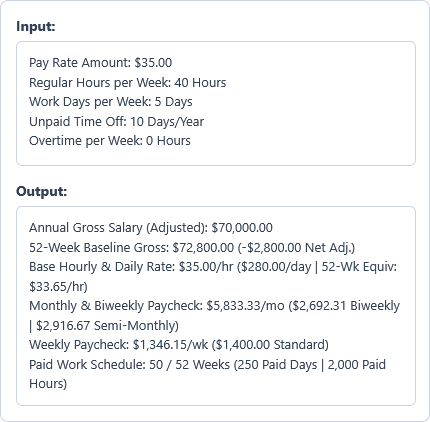
Pay Rate Amount: $35.00
Regular Hours per Week: 40 Hours
Work Days per Week: 5 Days
Unpaid Time Off: 10 Days/Year
Overtime per Week: 0 Hours
Options used: Pay Frequency: Hourly Wage ($/hr) | Overtime Rate Multiplier: 1.5x Rate
Example Output
Annual Gross Salary (Adjusted): $70,000.00
52-Week Baseline Gross: $72,800.00 (-$2,800.00 Net Adj.)
Base Hourly & Daily Rate: $35.00/hr ($280.00/day | 52-Wk Equiv: $33.65/hr)
Monthly & Biweekly Paycheck: $5,833.33/mo ($2,692.31 Biweekly | $2,916.67 Semi-Monthly)
Weekly Paycheck: $1,346.15/wk ($1,400.00 Standard)
Paid Work Schedule: 50 / 52 Weeks (250 Paid Days | 2,000 Paid Hours)
At $35.00 per hour on a 40-hour, 5-day schedule, a full 52-week year pays $72,800.00 gross. Taking 10 unpaid days off (2 workweeks) reduces annual pay by $2,800.00 to $70,000.00 across 50 paid weeks (2,000 hours). That adjusted total equals $5,833.33 per month, $2,692.31 biweekly, or a $33.65/hr equivalent rate across a 52-week year.
Frequently Asked Questions
How do you convert an hourly wage to an annual salary?
Multiply your hourly wage by your regular weekly hours and then by 52 weeks per year, which equals 2,080 paid hours on a 40-hour workweek. For a quick mental estimate, double your hourly rate and add three zeros for 2,000 hours. Then add 80 hours of pay: at $35.00/hr, that is $70,000.00 plus $2,800.00, or $72,800.00 per year.
What is the difference between biweekly and semi-monthly paychecks?
Biweekly payroll pays you every two weeks for a total of 26 paychecks per year (80 hours per check). Semi-monthly payroll pays you twice a month on fixed calendar dates for 24 paychecks per year (86.67 hours per check). For the same annual salary, each semi-monthly gross paycheck is 8.33% larger, while biweekly workers receive three paychecks during two months of the year.
How does unpaid time off affect an hourly worker's annual income?
Hourly workers and contractors without paid time off (PTO) lose one full day's pay (8 hours on a 40-hour, 5-day week) for each unpaid absence. Taking 10 unpaid days off (two workweeks) reduces a 52-week schedule to 50 paid weeks (2,000 hours), cutting your annual gross income by 3.85%.
How do exempt salaried roles and non-exempt hourly jobs handle overtime?
Non-exempt hourly workers typically earn 1.25x to 2.0x their base rate for overtime, such as 1.5x beyond 40 weekly hours (U.S. FLSA) or 35–38 hours internationally. Exempt salaried employees receive a fixed annual salary regardless of extra hours. Working 50 hours instead of 40 lowers a salaried worker's effective hourly pay by 20%.
What hourly rate should an independent contractor charge to match a full-time salary?
Independent contractors and self-employed freelancers (such as U.S. 1099 workers) typically charge 25% to 40% more per hour than a salaried employee's base rate. That markup covers unpaid holidays and vacation, employer social security or self-employment taxes, private health insurance, and retirement contributions.
Does this calculator store or transmit my salary and wage figures?
No, every wage conversion and paycheck schedule is calculated right on your own screen without saving or sending any data. Your hourly rates, job offer figures, and workweek settings never leave your device.